
One of the most rewarding elements of any yard landscape is a lush green lawn, until grubs are able to destroy it by tunnelling under the ground. These can be silent cancers of grass and when the grass is gone, there will be brown, spotty, and dead grass. When not addressed, it may take no time to spread the damage and even to attract creatures that may dig up your lawn looking to get food.
This detailed instruction guide will teach you precisely how to get rid of grubs in lawn, such as natural treatments, chemical treatments, and permanent prevention techniques that actually work.
If you want any professional help then DNRLandscaping provide their services of lawn care and more.
What Are Lawn Grubs and Why Are They Dangerous?
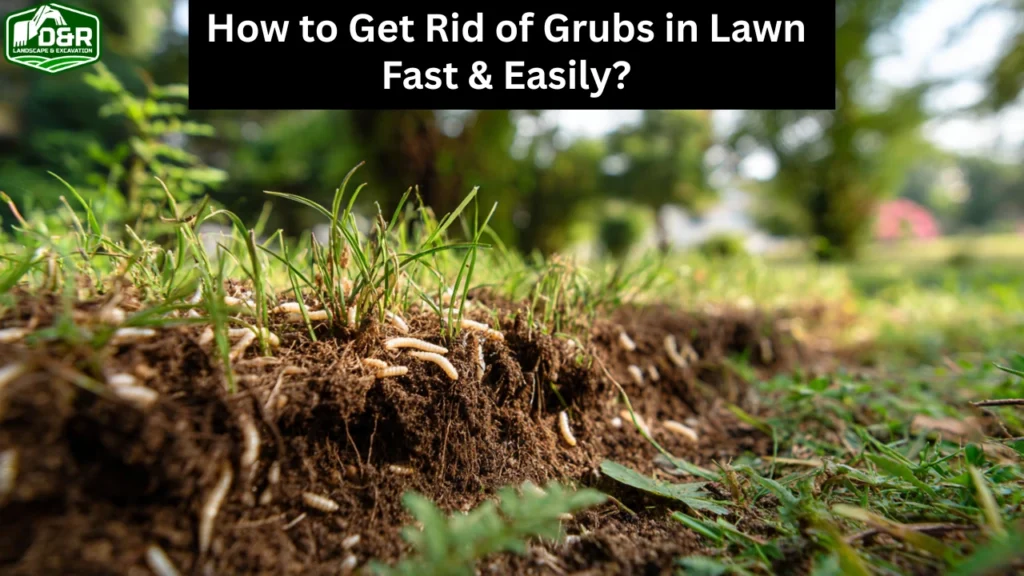
The larva form of beetles are known as lawn grubs, which are usually Japanese beetles and June bugs. These pests are found only a little beneath the soil and are known to feed on the grass roots. Although a few grubs might not have an apparent damage, an increasing population of the grubs can drastically damage your lawn.
Grasses cannot take in water and nutrients as the grubs feed on the root system. This causes dehydration, discoloration and ultimate death of the turf. The affected areas usually have a sudden manifestation although the infestation may have been going on underground in several weeks.
Understanding the Grub Life Cycle
Grubs have an important lifecycle that is important in the control of grubs. The eggs of beetles are deposited in the soil by adult beetles in early summer. These eggs are hatched into larvae (grubs), which starts feeding in late summer and early fall in an aggressive manner. They burrow even deeper into the soil and are inactive throughout the winter as temperatures drop.
They resume up near the surface in spring and are fed once more prior to becoming adult beetles. This process is repeated year by year, this is why it is important to time your treatment to succeed.
Signs You Have Grubs in Your Lawn
Grub attacks tend to fail to be differentiated with drought stress or diseases, yet there are distinct hints enabling you to spot the issue more precisely.
Among the initial symptoms, there are the appearance of irregular brown or yellow spots that do not show improvement with watering. Gradually, these patches enlarge and join hands giving birth to massive patches of grasses that are dead. The ground might be really soft or spongy when walking over the lawn as a result of damaged roots.
The other good indicator is the ease at which the grass can be taken off the soil. With the rotting away of the roots you could frequently pull upwards parts of turf as a loose-carpet. Also, grubs can be indicated by more activity of birds, raccoons, or moles since they dig the ground in order to eat grubs.
How to Confirm a Grub Infestation
In order to be sure, you may carry out a basic check-up. Take a piece of a lawn, a small square and lift it. Once you find a number of white, C-shaped larvae underneath, chances are that you are facing a grub problem. A population of grubs counted more than 8-10 grubs per square foot is usually the sign of a severe infestation which needs treatment.
When Is the Best Time to Get Rid of Grubs?
One of the most important aspects in learning how to get rid of grubs in your lawn is timing. Most home owners do treatments too late in their lives, thus leading to a low success and repeat infestation.
The best time to treat grubs is mid summer and early fall. The larvae are young during this, and are in a feeding condition, and are near to the earth surface, making it easier to get them. Late fall/early spring Treatment is much ineffective since the grubs will be deeper and treatments will not reach them easily.
Why Timing Matters More Than the Product
The strongest treatment taken will not work at the incorrect stage of the grub life cycle. There are various ways to get rid of the grubs, so knowing the timing to be most effective is important to use the most appropriate one. This is the reason why people in business are always focused on timing and not on product selection.
How to Get Rid of Grubs in Lawn (Proven Methods)
There are some sure methods of getting rid of grubs, and each of them is applicable in the case of the various amounts of the infestation and according to the personal taste.
Chemical Treatments for Fast and Effective Results
In extreme cases, chemical solutions can be the quickest option to treat severe cases. These are preventive grub treatments or treatments that are used to eliminate active grub babies that are already feeding in your lawn.
When using these products, it is also important to have a thorough watering of the lawn afterwards. This assists the treatment to get into the ground and the grubs where they reside. Although the treatments are very effective using chemicals should be done sensibly with consideration of the environment where pets or children normally play.
How to Get Rid of Grubs in Lawn Naturally
Natural processes can be taken as an effective alternative to the homeowners who want safer and environmentally-friendly solutions. It may take longer to show the results; however, it helps to achieve long-term soil health and sustainability.
Among the best natural solutions is beneficial nematodes. These microscopic agents actively attack and kill grubs without damaging plants or other useful insects. An alternative is milky spore, a naturally occurring bacterium that targets the grub populations in particular and is able to stay active in the soil over years.
Neem oil is used also as a natural pesticide. It interferes with growth of grubs and they fail to grow up into beetles. The techniques are especially helpful when one would like to have a chemical-free lawn.
DIY Home Remedies for Minor Infestations
In case the infestation is not in its too late stages, home remedies would suffice to control the number of grubs. Grubs can be brought to surface by pouring a mixture of dish soap and water on affected areas, thus making them easier to remove.
Another strategy that works is aeration of your lawn. It enhances the soil structure and exposes the grubs to the predators in the nature like birds. Moreover, your lawn can be caused to be less appealing to beetles seeking to lay eggs by cutting down on unnecessary watering.
These approaches are relatively cheap and simple to implement, but are typically not as effective as more specific interventions and only serve as supplements to a more comprehensive approach.
How to Get Rid of Grub Worms in Lawn Permanently
To gain long-term control, it is not possible to do it with one treatment. You must be able to fight grubs by both taking action and preventative measures.
This involves treating the lawn, at the appropriate time, ensuring a healthy lawn and keeping watch on your yard. Thick and healthy lawns will tend to be more resistant to grub damage, which will lower the risk of infestations in the future.
How to Get Rid of Grubs in Lawn with Standing Water
Poor drainage lawns are also quite susceptible to grubs. With wet soil, the beetles are able to lay eggs and the larvae to hatch.
Increasing drainage is critical in such situations. This can include filling operated areas with uneven soils, providing the soil with organic substances, or setting up efficient drainage whether in the soil or system. When the root of the problem is restored the use of an appropriate treatment is much more efficient.
Common Mistakes That Make Grub Problems Worse
Most of the homeowners unknowingly contribute to the problem of grubs by treating the situation at a later time or using ineffective measures. Another popular error is overwatering that stimulates the laying of more eggs in the soil by beetles.
Larger infestations that are more difficult to manage can also arise due to ignoring early warning signs. An active solution and working on the problem at the initial stage is the most appropriate way to behave.
How to Prevent Grubs from Coming Back
The best method of ensuring year-long healthy lawn is prevention. Routine landscaping activities are very fundamental in the control of grubs.
Keeping the mowing height is important in enhancing the root of the grass and the balanced fertilization is also important in promoting the overall health of the plant. Periodical inspections will enable you to respond to any possible infestations before they become serious problems.
Healthy and thick lawn naturally resists the pests and so, it would not be attractive to beetles to lay eggs.
Natural vs Chemical Grub Control: Which Is Better?
The decision between natural and chemical will be based on what is important to you and how much the infestation is severe. Chemical interventions are quick and suited to extreme situations and cases, and natural interventions are safer and more sustainable in the long-run.
In most situations, a combination of the two strategies may prove to be the most successful. Such as, treating an existing infestation with a chemical treatment and then making a transition to natural methods to prevent the long term.
Final Thoughts
Learning how to get rid of grubs in lawn necessitates a set of knowledge, time and doing it correctly. With proper identification of the signs, making selections correctly to treat the lawn, and practicing the correct day to day structural care of the lawn you can regain your lawn and keep it going.
The issue with the grubs can be a widespread issue and yet with proper management; they can be totally controlled.