
Clover appears harmless with its small white flowers and tender green leaves but to most homeowners it is a big bother within a short time. When the clover begins to spread, it has the ability to cover thin areas, crowd out grass, and make your lawn appearance uneven. You are not the only one who has found itself in a situation where it is necessary to know how to kill clover in lawn. This is a challenge that thousands of lawn enthusiasts grapple with each year.
And the good news is, that clover is manageable and preventable. We will discuss about DNR Landscaping‘s Professional services and natural remedies, selective herbicides, and important grass maintenance techniques that prevent the reappearance of clover, in this guide. You can have a beautiful, healthy lawn by knowing the reasons why clover grows and how to control it successfully.
Table of Contents
Understanding Clover and Why It Invades Lawns
Clover is a broadleaf perennial plant, the most common of which is white clover (Trifolium repens), found in residential lawns. Clover, unlike grass, is self-fertilizing, meaning that it is able to fix its own nitrogen hence they grow well in soils that are low in nutrient content. Although this may sound useful, it tends to give clover an advantage over weaker grass enabling it to proliferate swiftly.
Clover tends to grow in specific conditions of the lawn. It thrives in thin grasses, low nitrogen levels in the soil, or compacted lawns. Its growth is also caused by short mowing height, irregular watering, and untidy soil that is poorly drained. In a way, clover is mostly a manifestation of a lawn issue. When these conditions are uncontrolled, eliminating clover is a continuous struggle.
How to Kill Clover in Lawn: Approaches That Work
In relation to eradicating clover, two approaches exist. Homeowners have also the option of natural or chemical-free methods or selective treatments with herbicides. These two strategies have merits, which depend on the extent of the infestation, your lawn care objectives, and the chemical tolerance.
Natural solutions are superior to small lawns, organic gardeners, and households with pets or kids. These plans are aimed at eliminating clover without damaging your lawn or the environment. Conversely, herbicides tend to be more efficient with large-scale infestations and can offer quicker outcomes. A combination of both good lawn care habits and special treatments will provide the most long term solution ideally.
How to Naturally Kill Clover in Lawn
In case you are chemical-free, there are some natural ways to control and possibly get rid of clover. These methods are safe and sustainable, yet slower than herbicides.
Manual Removal
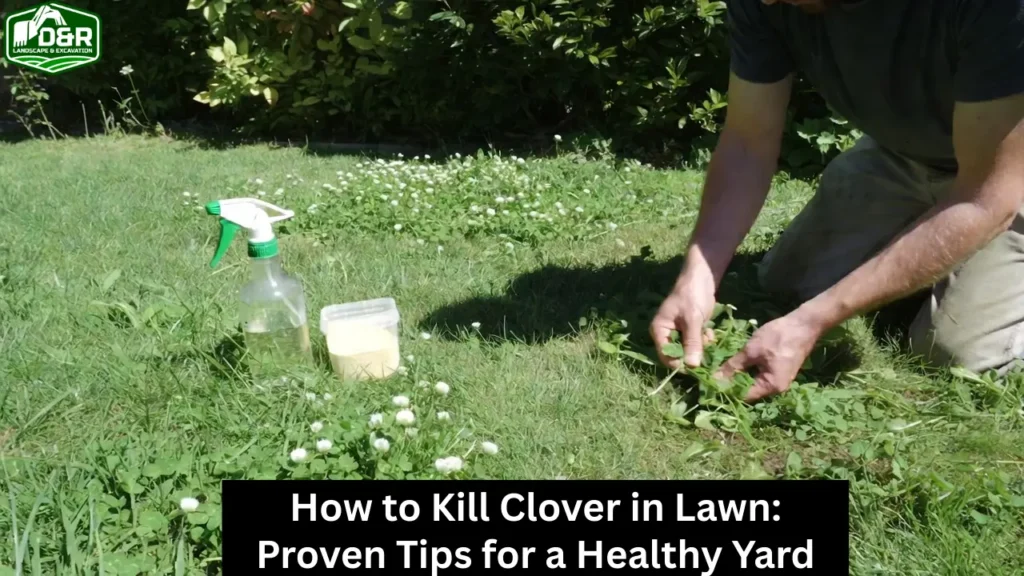
To remove small areas of clover, hand weeding is a viable and simple tool. The trick is to take out the whole root system. Clover propagates through creeping stems and abandoning any roots enables it to grow again. Before pulling, it is important to loosen the soil with a hand tool so that you are able to pull as much of the plant as possible. This method is most effective when the soil is wet since roots can be brought out easily.
Improve Soil Nitrogen Levels
Clover grows well in low nitrogen soil and this is perhaps the root cause of its presence in your lawn. Thickening and strengthening your grass can be assisted by applying a nitrogen based fertilizer or compost. With time, the clover is naturally replaced by healthy grass, which eliminates the repeated application of treatments. This is especially useful among homeowners who desire a long-term solution which is chemical-free.
Vinegar Spot Treatment
A combination of vinegar mixed with a few drops of dish soap can be used as a natural herbicide. Direct application of this solution to clover leaves may result in their burning and subsequent death of the plants. Nevertheless, vinegar is not discriminatory, and it can also damage grass. It should be applied as a spot treatment in isolated patches and not to the entire lawn because of this reason. When using vinegar, it is important to apply it on a sunny day when it is calm to make sure that the solution sticks to the leaves and does not fall off.
Corn Gluten Meal
Corn gluten meal is a pre-emergent that inhibits the germination of clover seeds. Although it does not kill clover that already grows, it slows down new growth to a great extent when used early in the season. Regular application of corn gluten meal, along with appropriate mowing and fertilization, may substantially decrease the occurrence of clover outbreaks in the future.
Mowing Practices to Suppress Clover
Clover grows better when lawns are shortened. By increasing your mowing height to three to three and a half inches, grass can cover the soil and clover will not be able to proliferate. Frequent mowing and scalping the lawn off should also make the grass grow thick thereby creating some natural competition that will keep weeds at bay.
How to Kill Clover in Lawns Using Herbicides
In case of moderate to heavy cases of clover, selective herbicides tend to be the most effective remedy. These products are tailored to attack broadleaf weeds such as clover and leave turfgrass untouched when used properly.
Selective herbicides that have a mixture of 2,4-D, dicamba, triclopyr, or quinclorac are very effective. They act by being absorbed into the plant, which ultimately kills the roots and makes them unable to grow. To maximize the effects, the application of herbicides should occur during late spring when the plant is growing or during early fall before the plant goes into a dormant state. Use herbicides only in extreme heat, drought and stress as this may damage your lawn.
Chemical treatments need safety. Always prepare according to the instructions of the manufacturer, use protective equipment and ensure that children and pets do not go on the treated lawn until it becomes safe to walk on again.
Lawn Maintenance Practices That Prevent Clover
Removing clover is not the solution. The only way to prevent its recurrence is by taking care of the lawn. Clover is naturally repelling to healthy lawns, and a number of measures can be taken to keep this status quo.
Soil Testing
A soil test is used to measure the nutrient deficiencies and pH levels. Creating a post-soil analysis of fertilizer is an option as clover grows in poor nitrogen soils, which eliminates future infestations. The testing also makes sure that you put the appropriate amount of nutrients in the soil without excessively fertilizing it, which will make the grass healthier and without giving the weeds an invitation to multiply.
Overseeding Thin Areas
Thin or bare areas encourage the growth of weeds such as clover. Planting such areas with high-quality turfgrass seed assists in thickening your lawn, which forms a dense covering that has no space for clover to flourish. This habit, together with fertilization, guarantees a lawn which can naturally outcompete weeds.
Aeration
Compressed soil suppresses the growth of grass roots but has less impact on clover. Aeration of your lawn, particularly in high traffic, enhances the penetration of air, water, and nutrients. The tougher grass roots can withstand the clover and other weeds.
Proper Watering
Superficial, frequent watering encourages weak grasses and promotes the growth of clover. Rather, water profoundly and sparingly to promote deep rooting. A well-established lawn is healthier, more resistant to drought, and has the capacity to suppress weeds naturally.
Natural vs Chemical Methods: Finding the Right Balance
The decision to adopt either natural or chemical approaches depends on the size and condition of your lawn and what you want to do. Natural alternatives are less fast, but pets, children and the environment are safer. They are effective with the right soil care, mowing methods, and watering habits.
Herbicides are quicker acting and in many cases required where the patch of clover is large or persistent. Nevertheless, the most effective long-term approach consists in the integration of the two methods: kill out the existing clover with the herbicides in case of necessity, and enrich your lawn with natural treatment to prevent future infestation.
Conclusion: The Secret to a Clover-Free Lawn
The main clue to the successful management of clover is to realize that it is frequently a symptom of lawn stress and not merely an unpleasant plant. Natural inhibitors of the growth of clover include healthy, thick grass, which will cause your lawn to resist weeds in the long-term. Integrate good elimination practices, be it natural or chemical with regular lawn care measures such as proper fertilization, mowing, watering, aeration and overseeding.
With a holistic approach, you will be able to eradicate clover, bring back the greenery of your lawn, and prevent infestations in the future. It is possible to have a thick, green, and weed-free lawn with patience and regular care.
FAQs About How To Kill Clover In Lawn?
Does fertilizer kill clover?
Clover is not killed by fertilizer itself. It makes grass stronger, and eventually it overgrows clover in the long run and when mowed and watered properly.
Will vinegar kill clover without harming grass?
No. Vinegar is indiscriminate and may harm grass when not used selectively. It works best as a topical spot treatment on small areas.
Why does clover keep returning?
Clover is successful with the weak, thin, or nutrient-deficient lawn. Clover will re-emerge after being removed without focusing on the underlying health of the lawn.
Is clover ever beneficial for lawns?
Certain house owners purposely plant micro-clover as it fixes nitrogen and needs fewer fertilizers. Nevertheless, in the case of regular turf grass, it is generally regarded as a weed.